
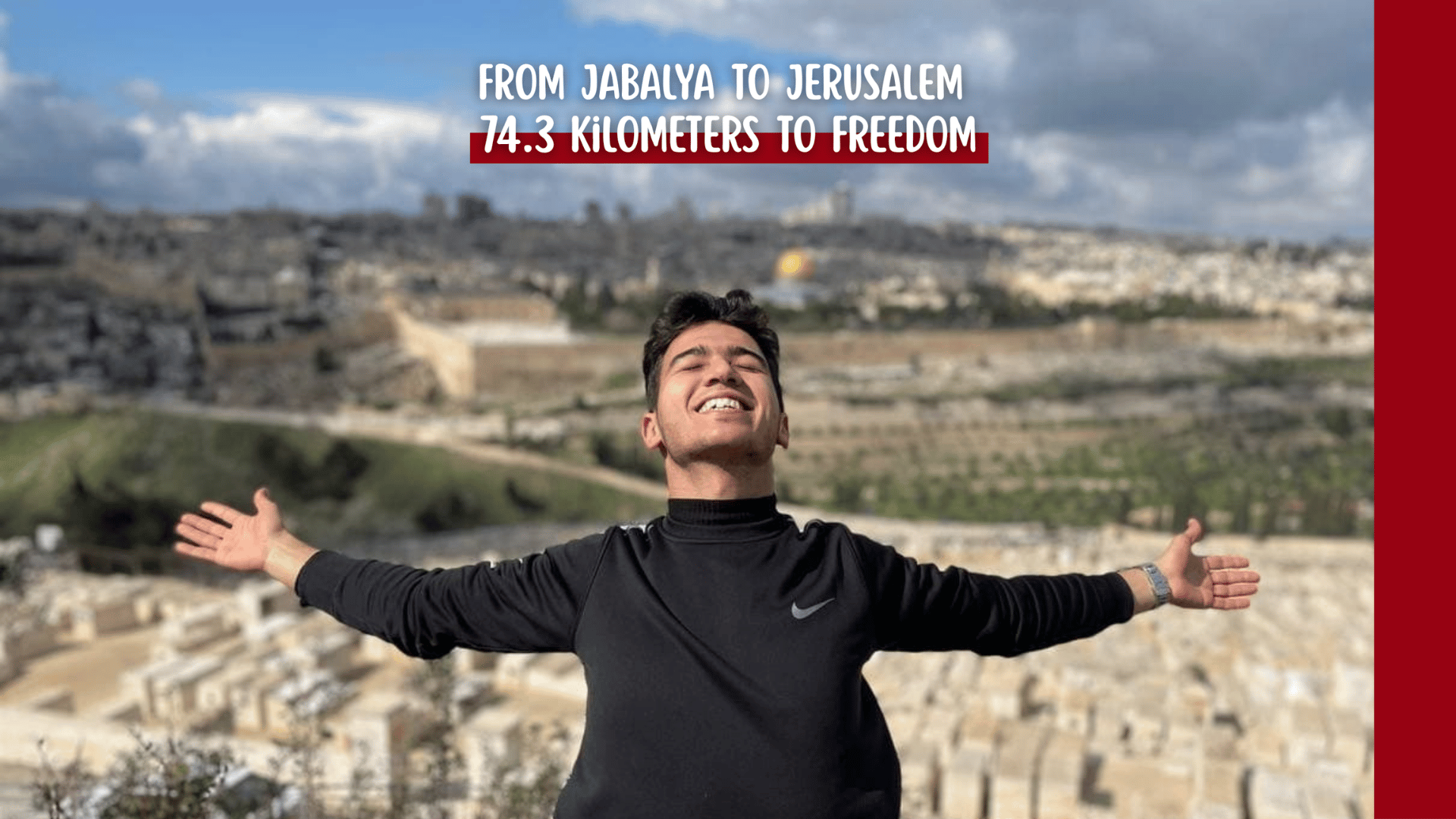
Atta Khaled
From Jabalya to Jerusalem, My First Breath Outside Gaza
or From Jabalya to Jerusalem, 74.3 Kilometers to Freedom
Most people won’t understand what it means to dream of traveling just 74 kilometers. But when you’re from Gaza, that distance can feel like an entire universe.
For 21 years, I lived behind walls, surrounded by fences, checkpoints, and the constant hum of restrictions. I had never seen the West Bank, never left Gaza, never truly breathed. But in February 2022, something changed. I was given three days. Three days to leave. Three days to see.
And for the first time in my life, I felt free.
It started with an email.
I had been selected as a member of the first Youth Advisory Panel for the State of Palestine. I remember reading it over and over, hardly believing it. After months of interviews and Zoom calls, I was finally going to meet the team, in person, in Ramallah.
The night before I left felt like the night before Eid. I couldn’t sleep. Every hour, I woke up to check the time, afraid I’d miss the chance of a lifetime. I left home at 7:30 a.m., saying goodbye to my family through tears, happy tears, but still the kind that carry all the weight of living in Gaza.
By 11 a.m., I took my first breath outside.
On the road to Ramallah, I pressed my face to the window, overwhelmed by the simplest things, trees, hills, even highways. I wanted to capture every second, but I also wanted to live it. I felt like I had stepped into a world I had only known through pictures.
By early afternoon, we arrived in Ramallah. I took my first photo with my teammates at Caesar Hotel. The city welcomed us like we were its own. The rain fell, fog blanketed the streets, and yet I felt warmth everywhere. That night, I visited Jericho and spoke with friends about life in Gaza versus life here. The differences felt like worlds apart, but we were still the same people, connected by something deeper.
I couldn’t sleep that night. None of us could. Even though COVID guidelines had put us in separate rooms, we all ended up together, sharing stories, memories, feelings we didn’t know we had. I realized something profound: I had prayed Fajr in Gaza, and Isha in the West Bank. Two cities. One homeland. One heart.
The next morning, we finally met our West Bank teammates face to face, no screens, no lag, no blackouts. Just presence. We learned about identity, history, and the realities that divide our people. And then we explored again, ice cream at Rokab, photos at Al-Manara, coffee in an old café full of Palestinian antiques and soul.
But my heart started to ache. I didn’t want to leave.
That night, I went back out, alone, wandering the streets. I wanted to say goodbye to everything, the corners I had walked, the lights I had seen, the freedom I had felt. For hours, I got lost on purpose. By 3 a.m., I found myself back where I started, but changed forever.
On our way back to Gaza, I begged for one more stop.
Just a glimpse of Al-Aqsa.
Time was short. The border would close soon. But somehow, it happened. We stopped at the Mount of Olives. There it was, Al-Aqsa Mosque, glowing with a kind of beauty that breaks your heart.
I couldn’t speak. My heart beat wildly, and my tears did all the talking. To be that close, and still unable to enter… it hurt in a way I can’t explain. Yet even for a few moments, I felt something sacred pass through me.
Then we left. I left my heart there.
Now I’m back in Gaza. The border has closed behind me, but something inside me is still open. I’ve tasted movement. I’ve seen the other side. I’ve met my people not through a screen, but through shared breath and laughter.
Still, I ask myself: why did I need four border crossings and an occupation permit just to visit another part of my own country?
That trip was a dream come true. But freedom of movement shouldn’t be a dream.
It should be a right.